Product Datasheet
AI pre-construction for commercial construction — Office, Retail, Multi-Family, Light Industrial, Municipal, and more.
Datasheet at a Glance
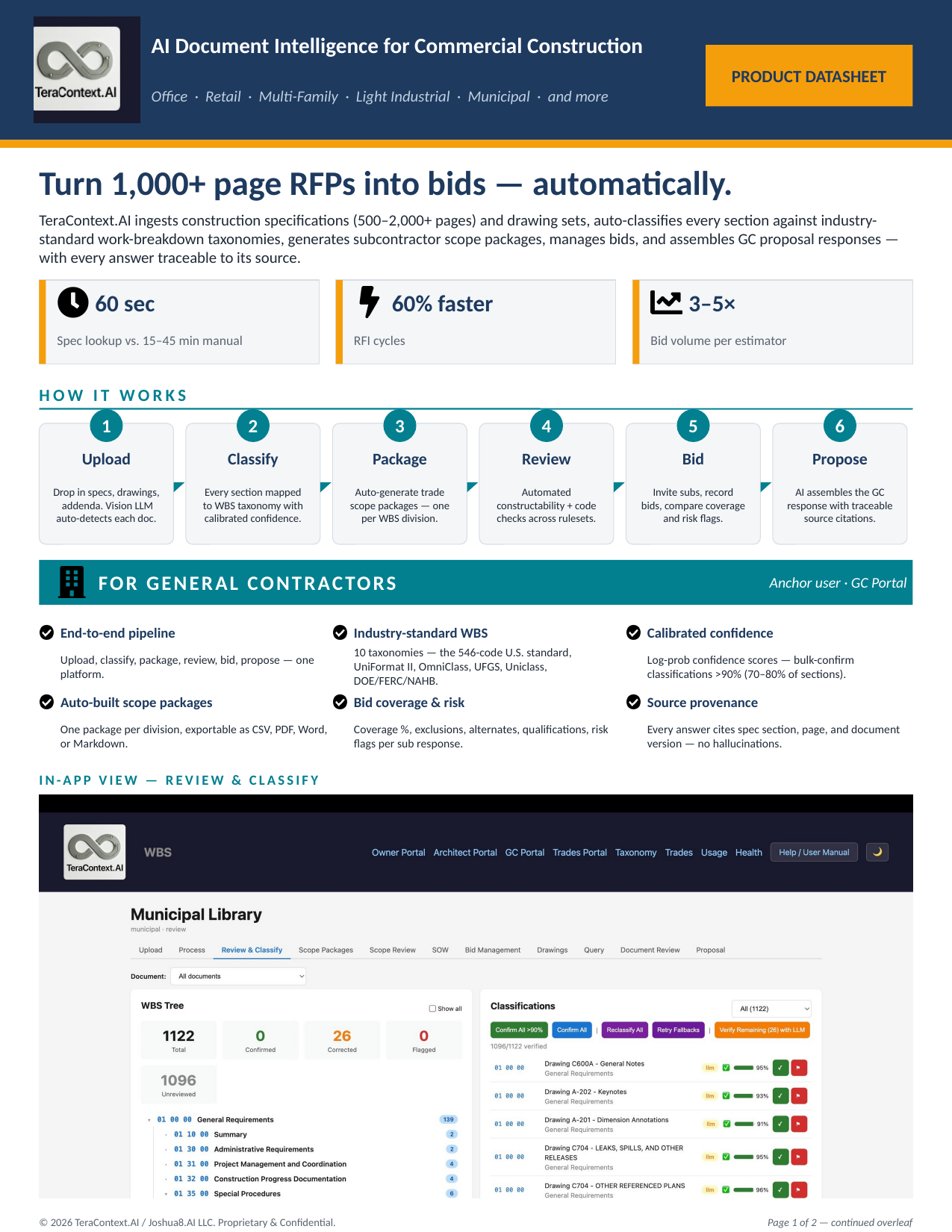
TeraContext.AI ingests construction specifications (500–2,000+ pages) and drawing sets, auto-classifies every section against industry-standard work-breakdown taxonomies, generates subcontractor scope packages, manages bids, and assembles GC proposal responses — with every answer traceable to its source.
How It Works
- Upload — Drop in specs, drawings, and addenda. A vision LLM auto-detects each document type.
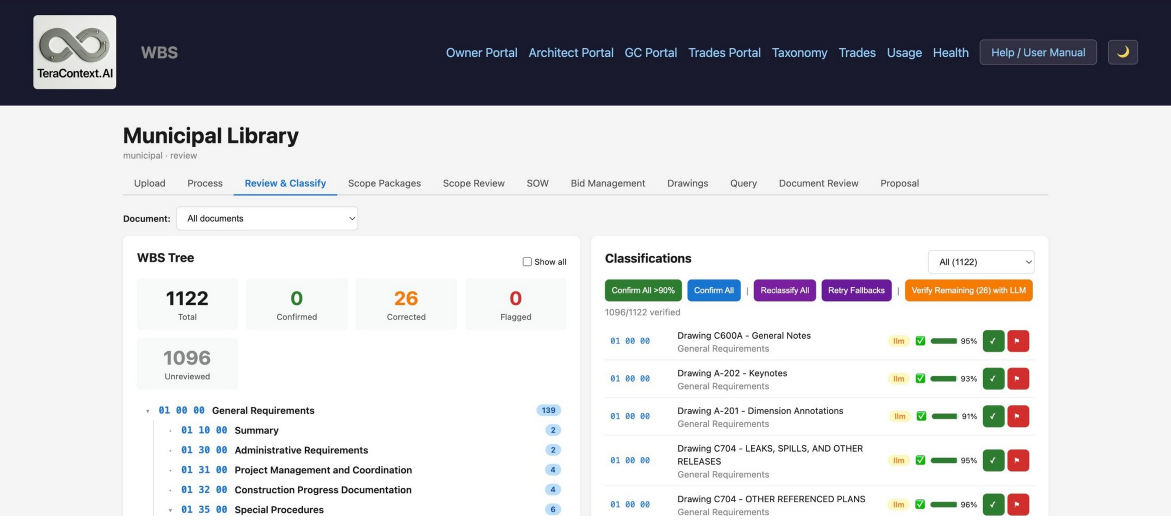
- Classify — Every section is mapped to a WBS taxonomy with a calibrated confidence score.
- Package — Trade scope packages are generated automatically, one per WBS division.
- Review — Automated constructability and code checks run across rulesets.
- Bid — Invite subs, record bids, and compare coverage and risk flags.
- Propose — AI assembles the GC response with traceable source citations.
For General Contractors
- End-to-end pipeline — upload, classify, package, review, bid, and propose in one platform.
- Auto-built scope packages — one package per division, exportable as CSV, PDF, Word, or Markdown.
- Industry-standard WBS — 11 industry-standard WBS formats, including UFGS, PennDOT-408, DOE, FERC, EPRI, and NAHB.
- Calibrated confidence — log-prob confidence scores let estimators bulk-confirm classifications above 90%, typically 70–80% of sections.
- Bid coverage and risk — coverage percentage, exclusions, alternates, qualifications, and risk flags for every sub response.
- Source provenance — every answer cites spec section, page, and document version.
For Owner Representatives
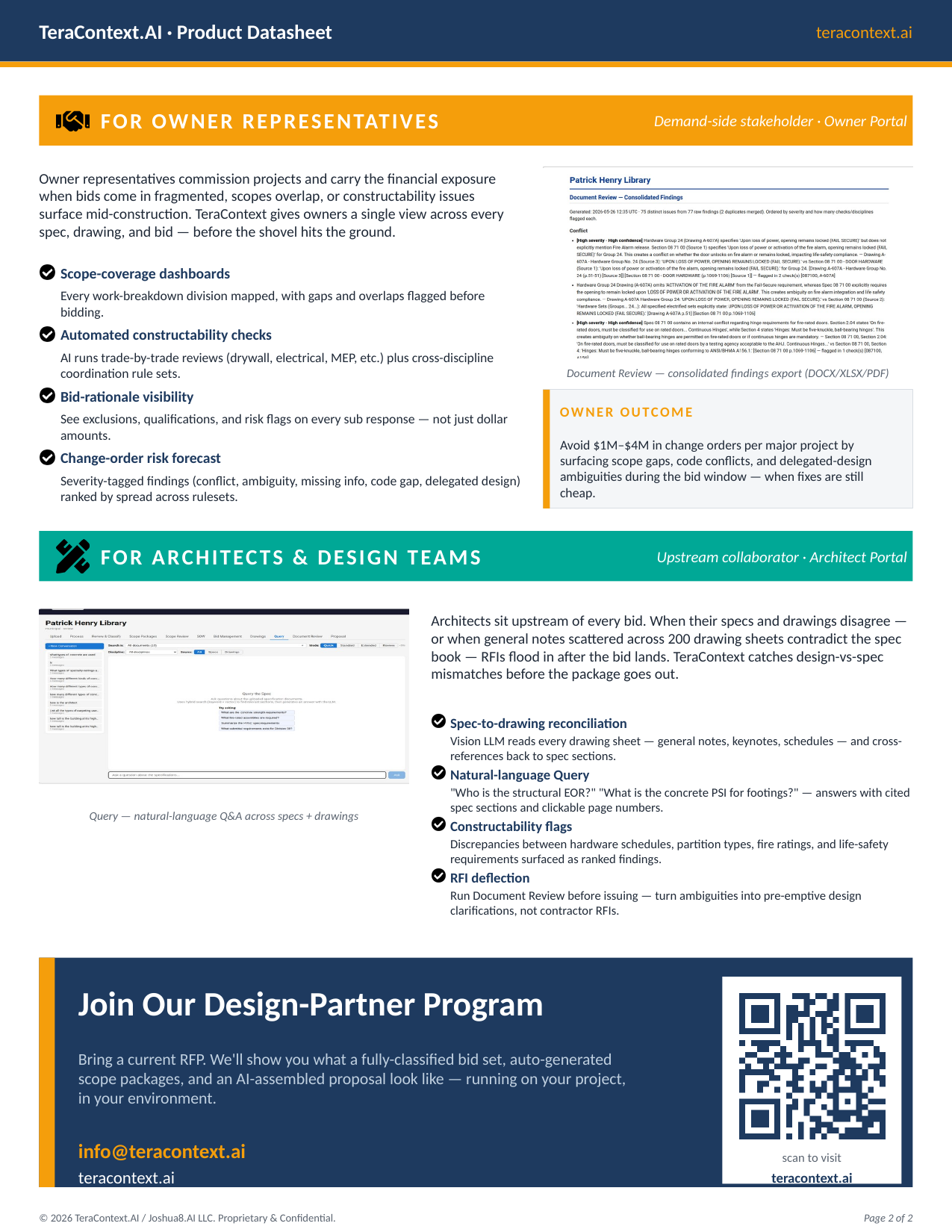
- Scope-coverage dashboards — every work-breakdown division mapped, with gaps and overlaps flagged before bidding.
- Automated constructability checks — trade-by-trade reviews (drywall, electrical, MEP) plus cross-discipline coordination rule sets.
- Bid-rationale visibility — exclusions, qualifications, and risk flags on every sub response, not just dollar amounts.
- Change-order risk findings — severity-tagged findings (conflict, ambiguity, missing info, code gap, delegated design) ranked by spread across rulesets.
For Architects and Design Teams
- Spec-to-drawing reconciliation — a vision LLM reads every drawing sheet (general notes, keynotes, schedules) and cross-references back to spec sections.
- Natural-language query — “Who is the structural EOR?” “What is the concrete PSI for footings?” — answered with cited spec sections and page numbers.
- Constructability flags — discrepancies between hardware schedules, partition types, fire ratings, and life-safety requirements surfaced as ranked findings.
- RFI deflection — run Document Review before issuing, so ambiguities become design clarifications instead of contractor RFIs.
Join the Design-Partner Program
Bring a current RFP. We’ll show you what a fully classified bid set, auto-generated scope packages, and an AI-assembled proposal look like — running on your project, in your environment. Apply for Early Access, download the datasheet PDF, or email info@teracontext.ai.